
赌神
杭州地铁运营将调整_我的网站

一 |
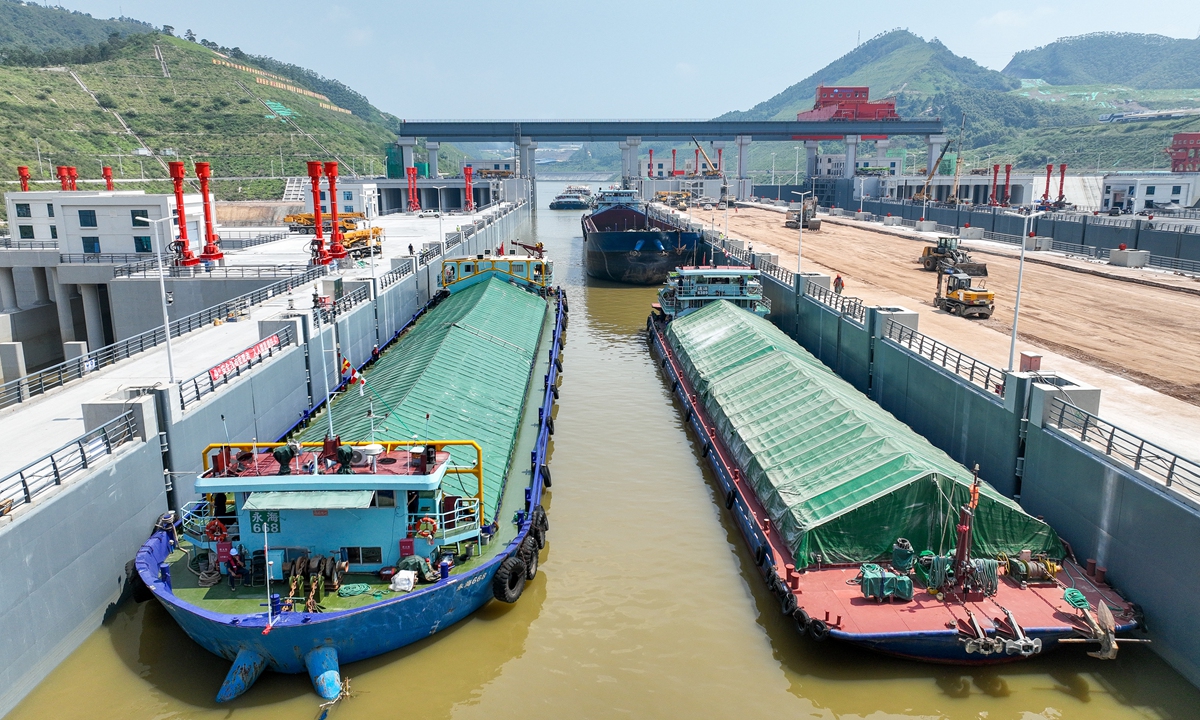
Equipped with China's homegrown BeiDou positioning systems, drones and sensors, four vessels began trial runs along China's Pinglu Canal on Wednesday. The canal, which is planned for opening in September, will greatly inject economic vitality to areas along its route and turbocharge China's trade connection with the ASEAN with its cost-saving transportation, a Chinese analyst said.
The vessels conducting trials on Wednesday represent the main types expected to sail on this canal, namely loaded and unloaded 5,000-tonne ships as well as loaded 3,000-tonne and 1,000-tonne vessels, Xinhua News Agency reported.
The trials began when an unloaded 5,000-ton vessel departed from the Xinfu service area along the canal in South China's Guangxi Zhuang Autonomous Region, the Xinhua News Agency reported.
With sensors collect data on their routes, movements, water currents and safe distances between ships, the tests will assess navigation under both normal and adverse conditions and examine whether the canal's waterways, locks, anchorages, service areas and navigation facilities are ready for operation.
Chinese analysts said the tests starting on Wednesday, days after the canal completed its first full-route patrol, indicated that the canal is one step closer to its scheduled opening in September as final preparation work ramp up.
Zheng Ping, chief analyst at industry news portal chineseport.cn, told the Global Times on Wednesday that as a major project in the nation's water network, the opening of the canal later this year will bring sea changes to areas along its route with fresh economic opportunities with its role as a low-cost enabler for domestic and international trade.
"Inland water traffic has great advantage in transportation capacity and costs. While a train can typically carry 20 40-foot container or more, a waterborne vessel can easily carry over 100 such containers. So a five-times capacity is gained here, greatly reducing transportation costs for goods," Zheng said.
For goods that are not time sensitive, or for bulk cargo such as coal, aluminum or fertilizers, waterborne traffic has unparallel advantage, the expert noted.
The 134.2-kilometer-long Pinglu Canal is a key project of the New International Land-Sea Trade Corridor. With total investment exceeding 70 billion yuan ($10.37 billion), the canal begins at the Pingtang River estuary in Hengzhou, administered by Nanning, follows the Qinjiang River into the Beibu Gulf, according to Xinhua News Agency.
It is China's first major river-to-sea canal project planned and coordinated at the national level since 1949 and is designed to accommodate vessels of up to 5,000 tons.
In addition to facilitating transportation, modern canal system will also have the function of water resource diversion, flood control and irrigation, greatly boosting up local economic development, Zheng said.
Lei Xiaohua, deputy director of the Institute of Southeast Asian Studies at the Guangxi Academy of Social Sciences in South China's Guangxi Zhuang Autonomous Region, told the Global Times on Wednesday that the Pinglu Canal will serve as a new engine for the deep integration of industrial chains between China and ASEAN.
"Raw materials from ASEAN can enter China's hinterland via the Beibu Gulf ports at lower costs, while Chinese exports including aluminum products and building materials can reach Southeast Asia more efficiently," Lei said.
Against the backdrop of deep industrial chain integration between China and Vietnam, the canal, which offers a low-cost, high-capacity transport route, is poised to foster new models of cross-border industrial capacity cooperation, said Lei.
When operational in September, the canal will give inland regions in Southwest China a more direct river route to the sea. Cargo that previously had to travel eastward through the Port of Guangzhou will be able to head south directly toward ports in the Beibu Gulf, shortening some inland waterway journeys by about 560 kilometers, according to Xinhua.
The New International Land-Sea Trade Corridor is an international trade and logistics network connecting China's western regions to ASEAN countries and other overseas markets.
The corridor has continued to record strong trade growth. During the first half of 2026, imports and exports transported through the corridor by its participating regions reached 517.23 billion yuan, up 13 percent year-on-year and setting a new record for the same period, per data released by Chongqing municipal government.
The corridor's rail service handled a record 1.425 million 20-foot equivalent units of cargo in 2025, up 47.6 percent year-on-year. As of early June of 2026, its network reached 593 ports in 128 countries and regions.
。 杭州地铁中午发布消息,为了确保安全运营,根据交通运输部《城市轨道交通行车组织管理办法》以及《杭州市城市轨道交通管理条例》等有关规定,地铁运营将采取以下措施:当车站出入口积水达到一级水位警戒线时,将关闭该出入口;当车站通行出入口少于2个时,车站关闭暂停服务;当车站周边积水严重存在倒灌风险时,所在线路将采取停运措施;当台风风力达到一定级别时,高架线路将采取限速或停运措施。

二 | 台风期间,请市民关注天气预报,注意人身安全。

三 | 乘坐地铁时,及时关注运营调整信息,合理安排行程,乘坐地铁期间如遇紧急情况,遵从现场工作人员指引。感谢您的理解与配合!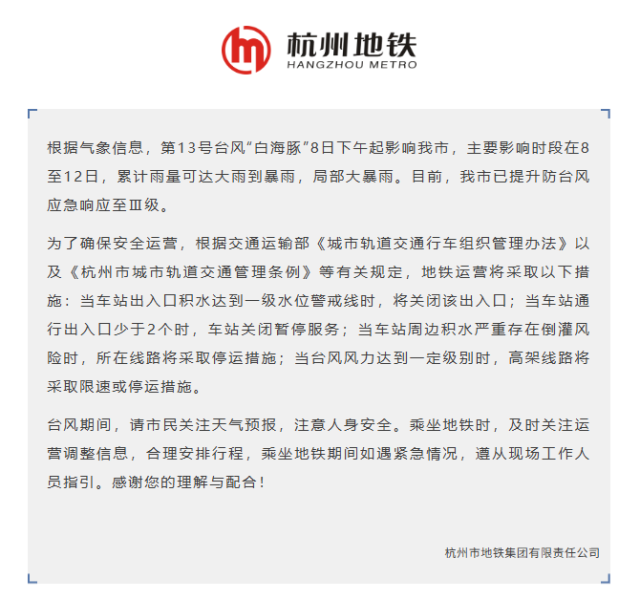 。
。
Current article:http://duo1jc.caonaishengpengchuali.shop/list_0su/5emctjo.html
Published on:01:08:51
栏目相关
- Republican Senator Says Inflation Reduction Act Will ‘Lead to a Worse Recession’
- 温网综合:纳达尔艰辛五盘胜 哈勒普横扫进四强
- 伊朗南呼罗珊省发生5.1级地震
- 《传奇新百区-盟重神兵》新服霸业8月26日14点火爆开服
- 《全球使命3》全新版本武器灭却之剑今日首登
- 通膨温和逐渐复苏NORDLYS(诺德利)看好亚太市场_投资_亚洲
- 宁夏中卫市海原县发生3.1级地震,震源深度14千米
- 西湖“长大”了 请你来说说家门口的变化!
- 微软成为最新一家开始裁员的科技公司 本轮数量低于1000人
- 劳伦斯奖晒近10年最佳男运动员获奖者:德约4次当选,梅西2次
- 兴城市红十字会发放救援物资惠及500余户群众
- 87% Indian Professionals Believe Sharing Emotions at Work Boosts Productivity, Morale: LinkedIn Poll
热门排行
- 哈兰德把一头秀发剪了!魔人布欧变寸头
- 夏普展示了DynaBook的30周年纪念笔记本:不到800克,带有第8代i5
- “张雪机车”遭台当局查扣 国台办:不得人心
- 金融监管总局:对恒大人寿保险有限公司吊销业务许可证,金融监管总局:对恒大人寿保险有限公司吊销业务许可证
- 普京下总统令后,俄军不宣而战,泽连斯基撑不住了?真相恰恰相反,鲸探所,原创 普京下总统令后,俄军不宣而战,泽连斯基撑不住了?真相恰恰相反
- 工信部通报 26 款存在侵害用户权益行为的 App 及 SDK
- Henan promotes paid leave policy to encourage flexible vacations
- 生意社2026年8月18日PTA行情观点:上涨
- 《GTA6》网飞新片即将到来:各地直播时间一览
- Digital Realty获50兆瓦额度,拟建在新加坡第四座数据中心
- 开勒股份:聘任魏翼丰担任公司董事会秘书
- 新研究显示超加工食品比外界想象的更不健康