海绵宝宝
$5,000 grew into a forest: American donor returns to China to reunite with desert reclamation partner_我的网站

一 |
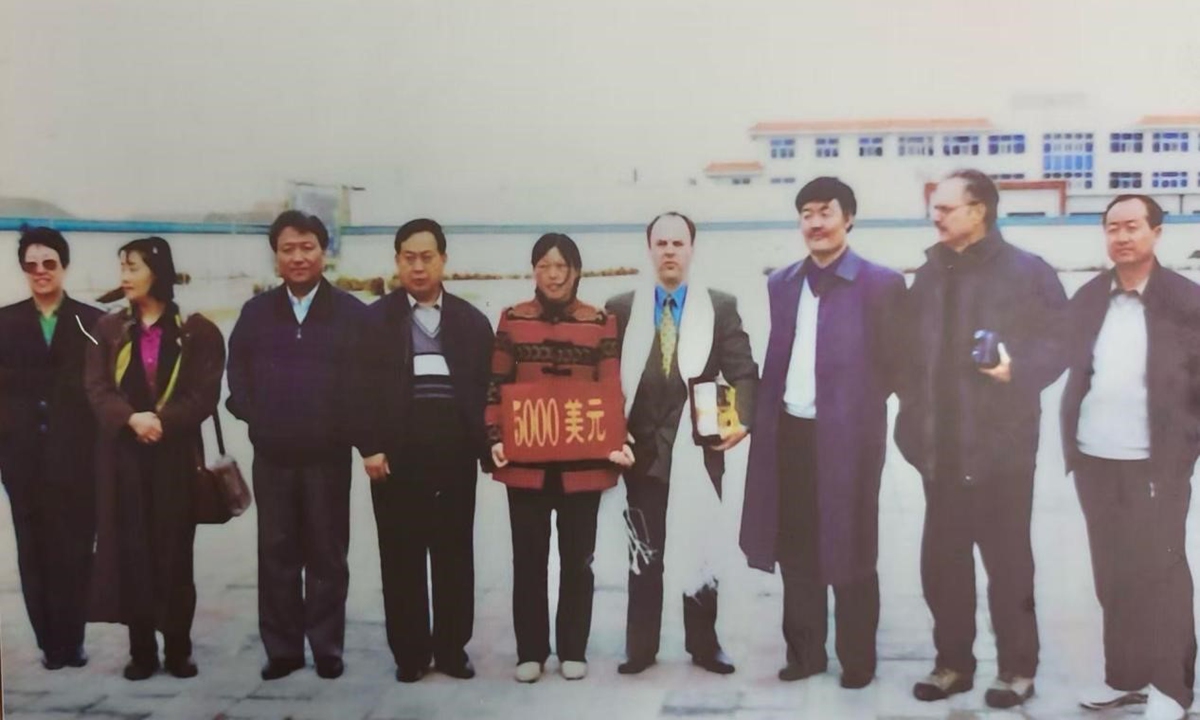
A group photo from the 1999 donation ceremony, where Ronald Sakolsky presents $5,000 for afforestation efforts. Photo: Courtesy of Luoyang No.2 Foreign Language School
At 2:48 am on early Sunday morning, after a flight of more than 10 hours, Ronald Sakolsky arrived at Beijing Capital International Airport. As he stepped into the arrivals hall, he greeted the waiting reporters with earnest Putonghua "Wo hui lai le," meaning "I'm back."
The thrill of his homecoming had washed over him most vividly during the final moments of his flight. "When I saw the lights in Beijing as we were landing is when I realized that I am back in my second home."
Sakolsky, an American retired teacher from Pennsylvania, is visiting China from Sunday to September 1 for a journey that will take him to Beijing, North China's Inner Mongolia Autonomous Region and Central China's Henan Province. It is a reunion nearly three decades in the making.
That reunion began with a single act of generosity. In 1999, when Sakolsky arrived in China as a participant in a bilateral teacher exchange program, he was moved by Yin Yuzhen and her husband's tireless efforts to curb desertification in the Mu Us Desert in Inner Mongolia. He raised $5,000 to fund their local tree-planting initiative. The young saplings bought with the donation have since matured into more than 50,000 full-grown trees, transforming the once desolate, sandy wasteland into a thriving green landscape.
After decades of lost contact, Yin, a national model worker renowned for her desert restoration achievements, launched an online search for her American benefactor in May, hoping to reconnect with the man who helped launch her lifelong desert reclamation mission.
What followed was a remarkable wave of online support: within less than 48 hours, a nationwide search had tracked Sakolsky down. That swift effort led to their long-awaited virtual reunion, a video call that brought them face to face for the first time in 27 years.
Asked what he is most looking forward to about this journey, Sakolsky told the Global Times that "I want to see Ms Yin, see the forests, see the students I have not seen for almost 30 years, my colleagues. I want to see the Chinese people."
The trip itself felt like a dream he never thought would come true, he added.
Now, the dream is about to come true. Later on Sunday, Sakolsky will fly to Ordos, Inner Mongolia, the site of the transformative environmental project that bound his fate with Yin's all those years ago.
During his China visit, Sakolsky will join Yin in a new tree-planting activity. He will also hold exchanges and discussions with teachers and students from the Luoyang No.2 Foreign Language School where he once taught, and participate in official China-US teacher exchange events, according to the Xinhua News Agency.
As he prepares to see the transformed landscape with his own eyes, Sakolsky shared with the Global Times about how much China itself has changed over the past two decades. From photographs, he said, he had already seen the barren desert he remembered turn into lush green forests; he had also heard that Luoyang has become far more vibrant and beautiful.
"Hopefully the message gets out to the world that Chinese and Americans can work together and make a peaceful world," he said.
。
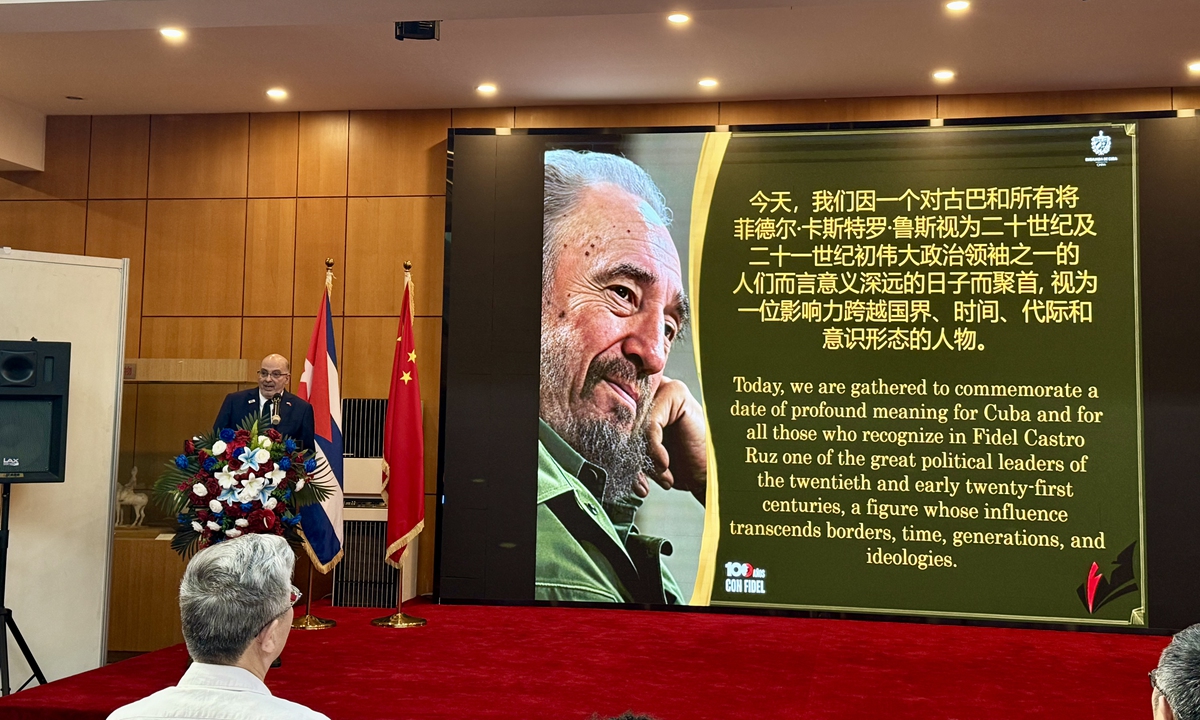
Alberto Blanco Silva, Cuban Ambassador to China, gives opening remarks at the commemoration in Beijing on August 13, 2026. Photo: Dong Feng/GTThe Embassy of the Republic of Cuba in China hosted a commemorating session in Beijing on August 13 to mark the centennial of the birth of the historical leader of the Cuban Revolution Fidel Castro Ruz. The event is not only about remembering an individual leader, but revisiting a decades-old relationship.
Delegates' speeches evaluated Fidel's role in promoting Cuba-China ties, especially when Cuba became the first Latin American and Caribbean country to establish diplomatic relations with China.
Alberto Blanco Silva, Cuban Ambassador to China, said in his opening remarks that the revolutionary leader is a figure whose influence transcends borders, time, generations, and ideologies.
Blanco noted that Fidel's life was devoted to Cuba's independence, social justice, solidarity among people, Latin American and Caribbean integration, and Global South, the socialist cause, and a more just and equitable international order.
Ambassador Blanco said that from Fidel, "we learned to practice solidarity through deeds, not merely beautiful words; to remain steadfast in the face of adversity and prudent in victory." For decades, Fidel's voice was echoed among developing countries, Blanco said, adding that Fidel promoted transformations that changed the course of Cuba's history.
Blanco also regarded Fidel as a statesman with a universal vision. Recalling the South Summit held in Havana, Cuba, in 2000, Ambassador Blanco quoted Fidel, saying "Globalization is an objective reality, which reveals our conditions as passengers abroad the same vessel - this planet inhabited by us all."
With this metaphor, Fidel illustrated the urgent need to unite global efforts as an international community to save the planet and humanity, preserve the future of our children, and reduce the gap between the North and the South, Blanco continued.
The Cuban Ambassador also noted Fidel's personal attention to China-Cuba relations.
Fidel, on behalf of the historic leadership, took the initiative, during a mass rally on September 2, 1960, to consult the people and announce the sovereign decision to establish diplomatic relations with the Government of the People's Republic of China, making Cuba the first country in the Western Hemisphere to dare take that step, the ambassador said, switching his speech from Spanish to Chinese.
Blanco added that it was Fidel who, with great frankness and courage, addressed the issue of the exclusion of the People's Republic of China and its admission to the United Nations in his speech before the United Nations on September 26, 1960.
Fidel also consistently upheld the one-China principle and, through his speeches and reflections, condemned interference in China's internal affairs and attempts to undermine the territorial integrity and sovereignty of the People's Republic of China. At the same time, Fidel helped foster mutual interest between Latin America and the Caribbean and China.
Moreover, Fidel instructed that the book,
The Long March, an account of a great military feat by Red Army in 1930s whose 90th anniversary we are commemorating this year, be published. Fidel knew its history in great detail and regarded it as an inexhaustible source of inspiration, Blanco recalled.
From Blanco's view, Fidel has helped forge a bond that today stands as an example of cooperation between a large country and a small one, based on equality and mutual respect.
The diplomat said that today, the joint construction of a China-Cuba community with a shared future is an expression of the high-level of strategic trust achieved between "our countries and opens new opportunities to expand cooperation for the benefit of both our peoples."
"One hundred years after his birth, Fidel Castro remains present in the memory of all those who are grateful to him and all those who defend just causes, both within and beyond Cuba," Blanco concluded.
One of the reasons why Fidel is still relevant today is that while people commemorate him, they are also reaffirming the value of the bilateral friendship, which Fidel forged and helped strengthen.
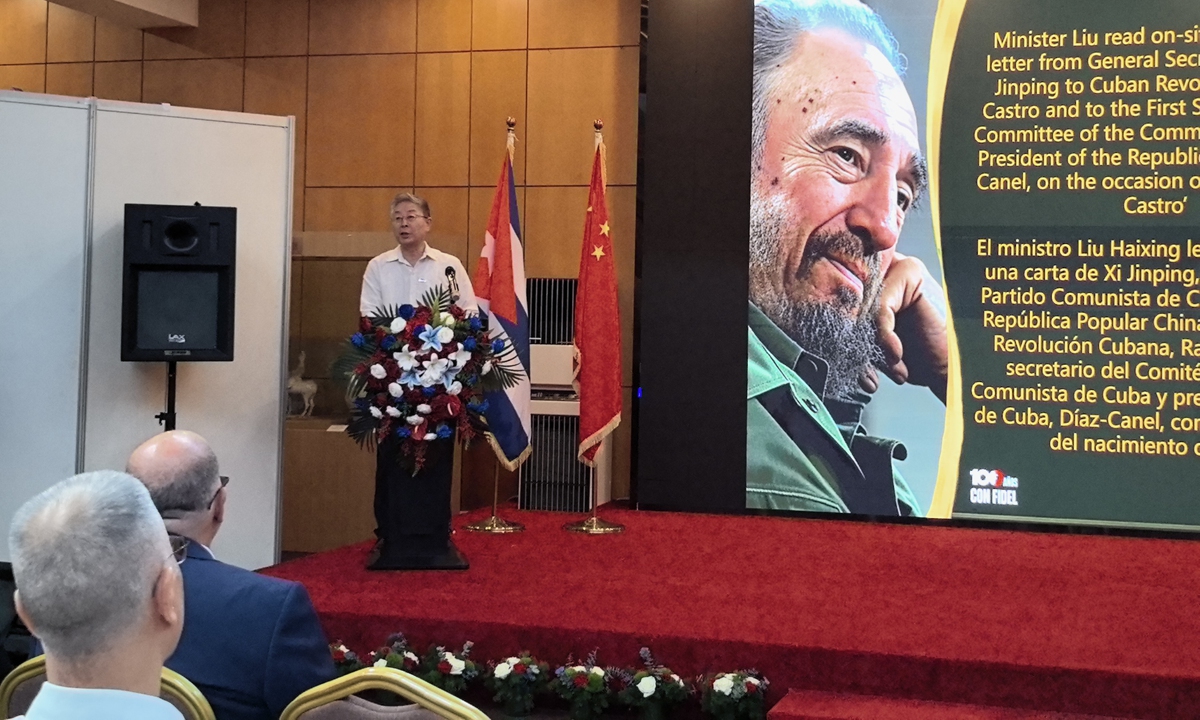
Ma Hui, Vice-minister of the International Department of the CPC Central Committee, gives a speech at the session in Beijing on August 13, 2026. Photo: Dong Feng/GT Ma Hui, Vice-minister of the International Department of the CPC Central Committee, said in his speech that Fidel was a founder of the Communist Party of Cuba and the socialist cause, and made significant contributions to Cuba's national independence and to international fairness and justice.
Ma served as Chinese Ambassador to Cuba from 2021 to 2024.
Ma said he visited on numerous occasions the Fidel Castro Center, which is located not far from the Chinese Embassy, as well as museums that feature Fidel.
"The more I learned about Comrade Fidel Castro, the more I was captivated by his noble character, outstanding qualities, and personal charisma," said Ma.
Fidel visited China twice and warmly received several Chinese leaders on their visits to Cuba, making historic contributions to the development of China-Cuba relations. The Chinese people will never forget him, Ma said.
In the current complex and evolving international landscape, China firmly supports Cuba in exploring a path of socialist development suited to its national conditions, firmly supports Cuba in safeguarding national sovereignty and security and opposing foreign interference, and stands ready to work together with Cuba and the wider international community to jointly uphold international fairness and justice, Ma stressed.
。
Current article:http://duo1jc.caonaishengpengchuali.shop/list_hktm7/pbmjte.html
Published on:08:40:26