成吉思汗
Philippine official fabricates ‘iron triangle’ narrative over Huangyan Dao; expert rebukes Manila’s smear attempt_我的网站

一 |
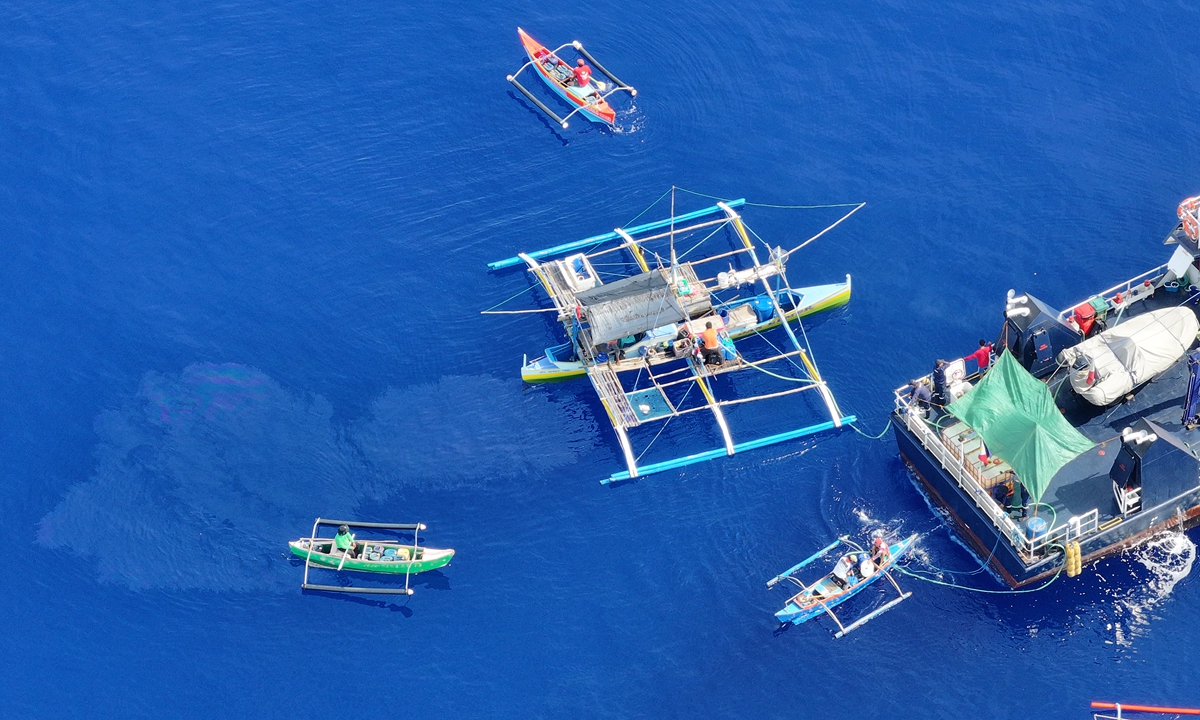
PCG spokesperson Jay Tarriela claimed on Monday that Huangyan Dao is the last remaining point needed to complete China's "iron triangle" in the disputed waters, according to Manila Bulletin.
Tarriela claimed during the National Maritime Council's (NMC) first semester press briefing in Manila that if connecting the Xisha Islands with Huangyan Dao, and Huangyan Dao with the Nansha Qundao, "it will allow China to dominate the entire maritime space of the South China Sea." He claimed that such pattern threatens freedom of navigation in a route carrying a large share of global trade.
In a social media post, Tarriela went further, alleging that if China "militarizes it (Huangyan Dao), the triangle closes and the danger stops being a Philippine problem."
China has never carried out any so-called "militarization" of Huangyan Dao. The latest claim is another victimhood narrative fabricated by certain people in the Philippines to portray the country as being threatened and rally other countries behind its position as freedom of navigation has been a closely watched topic internationally, Chen Xiangmiao, director of the World Navy Research Center at the National Institute for South China Sea Studies, told the Global Times, noting that China's activities around Huangyan Dao mainly involve routine patrols and law enforcement actions by the China Coast Guard to safeguard national sovereignty, security and maritime rights and interests.
China exercises sovereignty and jurisdiction over relevant waters in accordance with law. Even the deployment of law-enforcement forces or necessary defensive capabilities in relevant areas by no means freedom of navigation in the South China Sea would be affected, said Chen.
He argued that the South China Sea remains one of the world's busiest international shipping routes, and normal commercial navigation has never been obstructed by China. What the Philippines calls "freedom of navigation" appears to conflate commercial navigation with its demand that Philippine fishing vessels, coast guard ships, government vessels and even warships be allowed unrestricted access to waters around China's Huangyan Dao.
Last month, the Philippine side organized seven public vessels, three coast guard ships and one fish transport ship, and egged on a large number of fishing boats to illegally assemble in the waters under China's jurisdiction at Huangyan Dao, Jiang Lue, spokesperson for the China Coast Guard (CCG) said.
During this period, three Philippine public vessels - MMOV 3001, MMOV 3005 and MMOV 3017 - ignored repeated dissuasion and warnings from the CCG and obstinately intruded into the territorial waters of China's Huangyan Dao, Jiang added.
The CCG took necessary countermeasures in accordance with the law against the Philippine rights-violation vessels, including verbal warnings, blocking, and shooting water cannons, to resolutely expel them.
The Global Times learned that the Philippines harbored clear provocative intentions in this aggressive intrusion. Its vessel MMOV 3001 repeatedly charged at high speed into the 12-nautical-mile territorial waters surrounding China's Huangyan Dao. On-site footage obtained by the Global Times also shows this Philippine vessel was fitted with anti-collision padding, prepped for anticipated vessel collisions.
Also last month, Chinese foreign ministry firmly rejected and said it will never accept the delimitation of the so-called "baselines of the territorial sea" of China's territory of Huangyan Dao by the Philippines, stressing it is illegal, null and void.
The statement came after the Philippines claimed it has deposited its official nautical chart of Huangyan Dao and its surrounding maritime zones with the United Nations Secretariat.
With regard to the Philippines' illegal and false claims, China's Ministry of Foreign Affairs said in the Friday's statement that Huangyan Dao is China's inherent territory. China has indisputable sovereignty over it and its adjacent waters, and has sovereign rights and jurisdiction over the relevant waters. China has continuously, peacefully and effectively exercised sovereignty and jurisdiction over Huangyan Dao. The territory of the Philippines has been defined by a series of international treaties, and Huangyan Dao has never been a part of it. The Philippines' illegal territorial claim over China's Huangyan Dao is completely baseless under international law, according to the ministry.
Chen said that in fact, it is increasingly clear who is fueling militarization in the South China Sea. The Philippines has continued to strengthen their military presence and activities in the region in recent years. Manila's attempt to smear China's legitimate actions around Huangyan Dao as a threat to freedom of navigation is essentially a political narrative rather than a reflection of the actual state of navigation in the South China Sea.
。 IT之家 7 月 21 日消息,华为昨日面向部分机型推送了鸿蒙 HarmonyOS 6.1.0.135 新版本,进一步增强了图库 AI 修图中的沾色、魔法移图等功能,同时优化了部分场景的系统稳定性和使用体验。 ▲ IT之家开箱:华为 Mate 80 Pro Max 风驰版图赏 事实上,此次新版本更新日志并未完整呈现所有的新特性。IT之家在实测过程中发现,HarmonyOS 6.1.0.135 版本还有未公开的“隐藏”新特性: 默认图标优化,边缘新增光感特性 智慧生活 App 的耳机控制页面布局调整 支持对单应用音量调节(需手动开启开关后可用,路径:设置-声音和振动-应用音量单独调节) 修复设置-小艺-智能服务页面显示错位 Bug 华为 Mate X6 折叠屏手机新增支持内外屏设置不同壁纸 新增截屏直达服务 设置-钱包和支付新增独立设置选项 音悦家 App 支持华为 MatePad Edge 二合一平板电脑 优化设置首页顶部“云空间”和“查找设备”弹出动画 粒子光效增强 App 拖入大文件夹新增水波纹动画 目前,该版本仅面向 Mate 80、Mate X7、Pura X 等系列机型开启推送,Mate 60 系列、Pura 70 系列等预计将在下月开启推送。
Current article:http://duo1jc.caonaishengpengchuali.shop/yo66u/20260826/4156.html
Published on:19:52:49
 区委第一巡察组向被巡察单位党组织反馈巡察情况
 冲上热搜!“龚俊公司因服务合同纠纷被起诉”,龚俊方律所发文说明
 "독도는 대한민국 고유 영토" 경북도의회, 독도수호특위 본격 가동
 2025淘宝天猫618活动什么时候最便宜:618年中大促从6月16日20点到6月18日最便宜优惠!
 乌兹别克斯坦借力上合促旅游
 港澳台简讯:香港海关与巴基斯坦海关签订合作安排加强打击跨境犯罪活动